

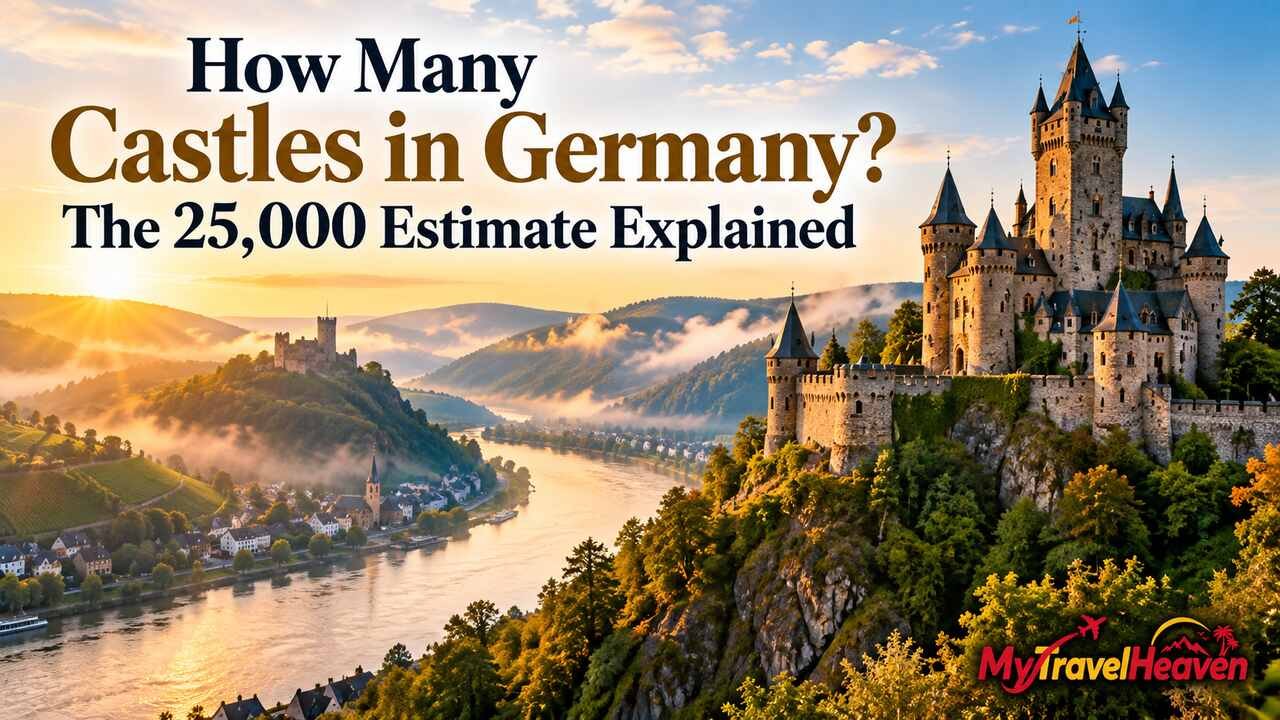
Germany is often described as a country with 25,000 castles, but that number needs some context. The most commonly cited estimate is that Germany has around 25,000 castles, palaces, and manor houses, ranging from preserved historic residences to ruins.
So, if you’re wondering how many castles are in Germany, the most useful short answer is approximately 25,000, provided you understand that the figure includes several kinds of historic buildings and sites rather than 25,000 intact medieval castles.
Are There Really 25,000 Castles in Germany?
The widely repeated figure of 25,000 does not mean Germany has exactly 25,000 standing medieval fortresses.
The estimate broadly covers castles, palaces, manor houses, and related historic sites. Some survive in impressive condition, while others are ruins or have undergone substantial reconstruction.
This distinction matters because the English word “castle” can blur several categories that are more clearly distinguished in German.
| German term | Approximate English meaning | Typical purpose |
|---|---|---|
| Burg | Castle or fortress | Defense and residence |
| Schloss | Palace or stately residence | Residence, prestige, and administration |
| Festung | Fortress | Primarily military defense |
| Herrenhaus | Manor house | Residence of a landed estate |
| Burgruine | Castle ruin | Remains of a former castle |
Consequently, two sources can give apparently different answers to the number of German castles without necessarily contradicting each other. One might count only medieval fortified castles, while another includes palaces, manor houses, and ruined sites.
Why Isn’t There an Exact Number of Castles in Germany?
There is no single, universally accepted inventory containing every German castle and related historic residence.
Germany consists of 16 federal states, and historic monuments are administered through different state-level systems. This makes producing a simple national total difficult.
Another complication is deciding what qualifies as a castle site. A building does not need towers, battlements, and furnished rooms to have historical significance.
Some sites are intact. Others have lost their roofs or survive as ruins. Still others have almost completely disappeared, leaving foundations, archaeological evidence, or historical records.
That makes a question such as “How many castles are still standing in Germany?” considerably harder to answer than it initially appears.
Why Does Germany Have So Many Castles?
Germany’s unusually rich castle landscape is closely connected to its political history.
For centuries, the territory of modern Germany was divided among numerous kingdoms, duchies, principalities, ecclesiastical territories, free cities, and smaller lordships. Local rulers and noble families needed defensible residences and visible centers of authority.
Castle construction was particularly important during the Middle Ages. Fortified sites protected families and territory while also controlling strategically valuable roads, river crossings, trade routes, and surrounding land.
Later rulers had different priorities. Instead of relying primarily on fortified residences, they constructed elaborate palaces intended to demonstrate wealth, status, and political power.
This long architectural history helps explain why Germany contains everything from medieval hilltop fortresses to enormous Baroque palaces and 19th-century Romantic interpretations of medieval architecture.
How Many German Castles Are Still Intact?
There is no authoritative current figure covering every intact castle in Germany.
The difference between the estimated total and the number of recognizable buildings is significant because historical inventories can include ruins and sites where little of the original structure remains.
Marksburg provides an unusually good example of survival. It is notable for escaping the destruction suffered by many other castles along the Middle Rhine.
Eltz Castle is another exceptional survivor. Its documented history stretches back to the Middle Ages, and it remained associated with the same family for centuries.
Therefore, the famous 25,000 figure should never be interpreted as 25,000 fully preserved castles that tourists can walk into today.
Where Are the Most Castles in Germany?
Castles occur throughout Germany, but several landscapes are particularly associated with them.
The Rhine Valley is probably the best-known castle landscape. The Upper Middle Rhine Valley contains a remarkable concentration of castles, ruins, historic towns, vineyards, and other cultural landmarks.
Other parts of Germany are also known for historic castles and residences. Saxony has numerous castles and palaces, while the Swabian Alb is associated with dramatic hilltop fortresses. Münsterland and parts of the Lower Rhine are particularly well known for moated castles.
Travelers who want to make castles the focus of an entire trip can also explore Germany’s Castle Road, a long-distance tourism route connecting numerous castles, palaces, and historic residences.
Famous Castles in Germany Worth Knowing
Germany’s enormous number of historic residences means there is no single representative “German castle.” A handful of famous sites demonstrate how different these buildings can be.
Neuschwanstein Castle
Neuschwanstein is probably Germany’s most internationally recognizable castle, but it is much younger than its medieval appearance suggests.
King Ludwig II of Bavaria commissioned it in the 19th century. Its foundation stone was laid in 1869, and construction incorporated relatively modern materials and technology behind its romanticized medieval appearance.
That makes Neuschwanstein an excellent example of why architectural appearance alone cannot tell you the age of a German castle.
Eltz Castle
Burg Eltz offers a very different experience. Its documented history stretches back to the 12th century, making it a genuine medieval castle rather than a later interpretation of medieval architecture.
The castle was expanded over centuries and remained associated with the same family. Its survival makes it particularly valuable for understanding how a medieval German castle developed over time.
Wartburg Castle
Wartburg, above Eisenach in Thuringia, combines architectural importance with major events in German cultural history.
It is particularly associated with Martin Luther, who stayed there in the early 1520s and worked on his German translation of the New Testament.
Wartburg Castle is also recognized as a UNESCO World Heritage Site.
Marksburg Castle
Marksburg stands above Braubach on the Rhine and is especially significant because it escaped the destruction suffered by many neighboring fortifications.
Its preservation offers visitors an unusual opportunity to explore a remarkably intact medieval Rhine castle.
Castle, Palace, Fortress, or Ruin: Why the Definition Changes the Count
The terminology is the biggest reason readers encounter conflicting numbers online.
A medieval Burg was generally designed with defense in mind. Its position, walls, towers, and entrances could help protect its occupants and surrounding territory.
A Schloss, by contrast, was primarily a prestigious residence. Defensive capability might be limited or irrelevant. English-language descriptions commonly translate Schloss as either “castle” or “palace,” depending on the individual property.
Neuschwanstein illustrates the difficulty perfectly. It is universally known in English as Neuschwanstein Castle, yet it was a 19th-century royal project inspired by an idealized medieval world rather than a functioning medieval defensive fortress.
Therefore, asking specifically for the number of medieval defensive castles, intact castles, or visitor-accessible castles would produce a much smaller number than the broad estimate of 25,000 historic properties and sites.
Can You Visit All 25,000 German Castles?
No. The estimated total includes places that are not conventional tourist attractions.
Some German castles and palaces operate as museums or major visitor destinations. Others remain privately owned, have been converted to hotels or other uses, survive only as ruins, or have disappeared almost entirely.
Even visiting the major publicly accessible castles would require considerable time.
A more practical approach is to choose a region. Travelers interested primarily in medieval fortifications could concentrate on the Rhine or Moselle valleys. Those interested in royal residences might prioritize Bavaria, Berlin, and Potsdam. Travelers interested in a dedicated road trip can follow sections of the Castle Road.
Conclusion
So, how many castles are in Germany? About 25,000 is the best-known estimate, but it should not be interpreted as an exact count of intact medieval castles. The figure broadly encompasses castles, palaces, manor houses, ruins, and other historic properties in very different states of preservation.
The number makes more sense when viewed as evidence of Germany’s exceptionally dense architectural heritage rather than as a literal inventory of 25,000 fairy-tale fortresses. From medieval survivors such as Eltz and Marksburg to the 19th-century Neuschwanstein, Germany’s historic residences span many centuries, architectural styles, and purposes.
FAQs
Does Germany really have 25,000 castles?
Approximately, but not in the narrow sense of 25,000 intact medieval castles. The widely cited estimate includes castles, palaces, manor houses, ruins, and other historic properties or sites. There is no definitive national count covering every category.
What is the most famous castle in Germany?
Neuschwanstein Castle in Bavaria is one of Germany’s best-known and most recognizable castles. Despite its medieval appearance, construction began in the 19th century under King Ludwig II.
Why are there so many castles along the Rhine?
The Rhine was historically an important transportation, commercial, and strategic corridor. Fortified positions overlooking the river offered territorial and economic advantages. Today, the Middle Rhine is particularly famous for its dense concentration of castles.
Are Germany’s castles all medieval?
No. Germany has medieval fortresses, Renaissance and Baroque residences, later palaces, and 19th-century Romantic buildings. Neuschwanstein, for example, was begun in 1869 despite deliberately evoking an idealized medieval castle.
Are any German castles UNESCO World Heritage Sites?
Yes. Wartburg Castle is a UNESCO World Heritage Site. The Upper Middle Rhine Valley, famous for its castle-filled cultural landscape, is also recognized by UNESCO, along with several other German palace and cultural sites.
Which part of Germany is best for seeing castles?
The Rhine Valley is one of the strongest choices for seeing numerous castles within a relatively compact area. Bavaria, Saxony, Thuringia, and the Moselle region also contain notable castles, palaces, and historic residences.

1 Comment
Pingback: Tower of London: Complete Visitor Guide