

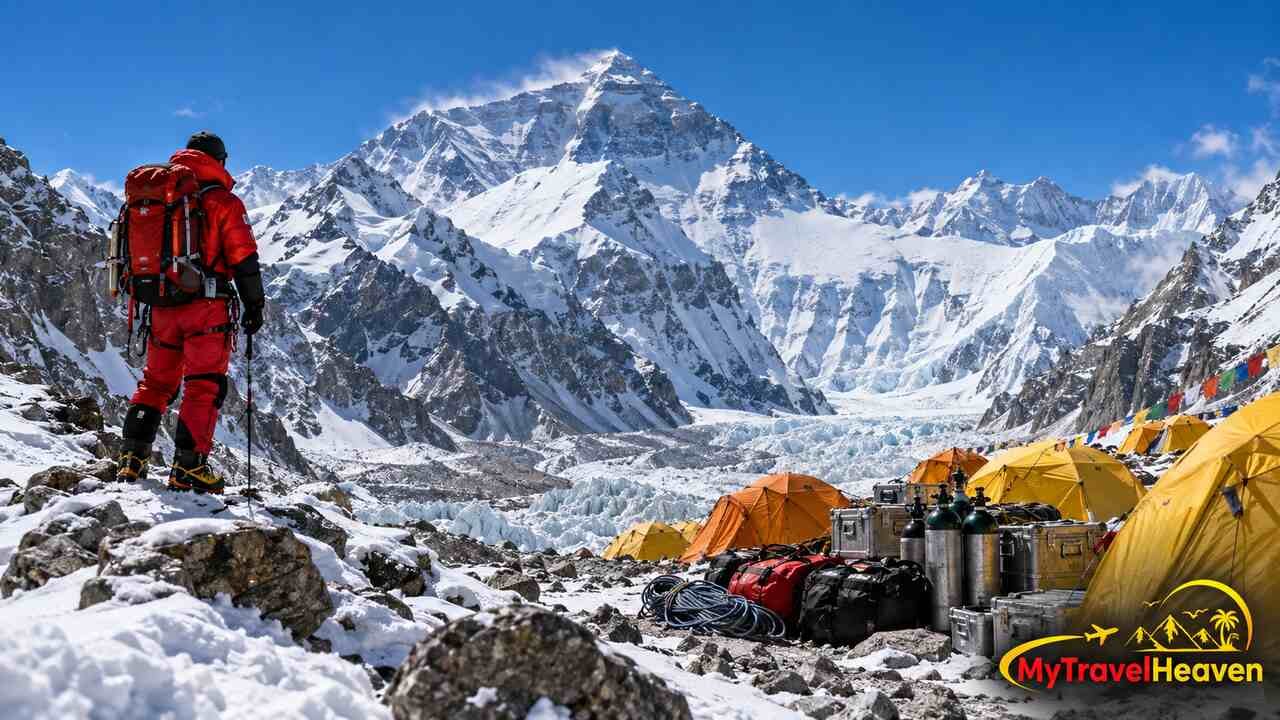
Climbing Mount Everest in 2026 typically costs about $45,000 to $100,000 per person for a professionally supported expedition from Nepal, although lower-priced packages exist and premium or private expeditions can exceed $150,000 to $200,000. Nepal’s government climbing permit alone now costs $15,000 per foreign climber during the main spring season, following a fee increase that took effect in September 2025.
The advertised expedition price is not always your final cost. Personal climbing equipment, international flights, insurance, tips, training climbs, extra accommodation and emergency expenses can add thousands or tens of thousands of dollars. A realistic budget therefore depends heavily on the operator, level of Sherpa and guide support, oxygen allocation and what the expedition package actually includes.
How Much Does It Cost to Climb Mount Everest?
For most climbers attempting Everest from Nepal’s South Col route, these figures provide a useful starting point:
| Type of Everest expedition | Approximate price |
|---|---|
| Lower-cost Sherpa-supported expedition | $35,000 to $50,000 |
| Mid-range supported expedition | $50,000 to $75,000 |
| Internationally guided expedition | $75,000 to $100,000+ |
| Premium or fast expedition | $100,000 to $150,000+ |
| Private or ultra-premium expedition | $150,000 to $200,000+ |
These are broad ranges rather than fixed prices. Current operator pricing shows how large the difference can be. Some premium 2026 Everest expeditions are priced close to $100,000 per person, while highly personalized or fast-track services can approach or exceed $200,000.
A 2026 market comparison of Nepal South Side expeditions placed the average price at around $61,000, with a median near $55,000, although individual offers varied considerably depending on service level.
The important distinction is between an expedition package price and your total personal Everest budget. A $55,000 package does not automatically mean you can reach Kathmandu with exactly $55,000 available.
The Mount Everest Climbing Permit Costs $15,000 in Spring
One of the largest unavoidable expenses is Nepal’s Everest climbing royalty.
Nepal increased the foreign-climber fee for the normal Everest route from $11,000 to $15,000 for the main spring climbing season. The new pricing took effect in September 2025.
| Nepal Everest season | Permit fee per foreign climber |
|---|---|
| Spring, the main April-May season | $15,000 |
| Autumn | $7,500 |
| Winter | $3,750 |
| Other low-season period | Approximately $3,750 |
The cheaper permit outside spring does not necessarily make a low-season Everest expedition cheaper or more practical. Spring offers the established commercial climbing infrastructure and generally preferred weather window. Attempting the mountain in winter or another difficult season can require substantially different logistics and carries additional environmental challenges.
The $15,000 royalty also does not buy an expedition package. It essentially provides government authorization to climb. Commercial expedition operators normally arrange the permit and incorporate it into their package pricing, so climbers should check whether a quoted price already includes it before adding $15,000 to their budget.
Nepal issued 494 permits for foreign climbers during the 2026 spring season, illustrating how significant permit revenue has become within the Everest climbing economy.
What Are You Actually Paying for on an Everest Expedition?
The permit receives plenty of attention because it has a clear government price, but operating an expedition at 8,848.86 metres is far more expensive than obtaining permission to climb.
Commercial expeditions must support climbers for weeks in one of the most remote and hostile environments on Earth. The price may cover Base Camp accommodation, cooks, food, communications, climbing staff, fixed-route infrastructure, oxygen transportation, high camps and extensive logistics between Kathmandu and Everest.
Typical expenses include:
| Expense | Typical budgeting consideration |
|---|---|
| Nepal spring climbing permit | $15,000 |
| Expedition logistics and Base Camp support | Usually incorporated into package price |
| Climbing Sherpa/high-altitude support | Can vary by staffing ratio and service |
| Supplemental oxygen | Several thousand dollars per climber |
| Personal mountaineering equipment | Roughly $5,000 to $10,000+ if starting from scratch |
| International transportation | Varies greatly by departure country |
| Rescue/travel insurance | Depends on age, nationality and coverage |
| Tips and summit bonuses | Operator-specific |
| Hotels and personal spending | Usually partly outside expedition package |
| Training and prerequisite expeditions | Potentially tens of thousands of dollars over several years |
Supplemental oxygen alone can cost several thousand dollars, while high-altitude Sherpa support can add substantially more depending on the level of service.
This is why comparing Everest operators based solely on the headline price can be misleading. Two $60,000 expeditions may include very different oxygen allowances, guide ratios, Base Camp services and emergency resources.
How Much Does Supplemental Oxygen Cost?
Most commercially guided Everest climbers use bottled oxygen above the higher camps. Oxygen expenses include more than the cylinders themselves. Regulators, masks, transport and oxygen used by high-altitude support staff all contribute to expedition costs.
A typical oxygen cylinder may cost roughly $550 to $650, with summit climbers often allocated multiple bottles. Six to eight cylinders can therefore cost approximately $3,000 to $4,800 before considering all support-related oxygen expenses.
Premium operators may provide larger oxygen allocations, higher flow rates and additional backup systems.
When comparing prices, useful questions include how many bottles are allocated to you, the expected flow rate, where oxygen begins, whether spare cylinders are available, and whether the personal Sherpa’s oxygen is included.
A seemingly cheaper expedition can become much less attractive if important high-altitude resources must be purchased separately.
Sherpa and Guide Support Can Change the Price Dramatically
Support levels are one of the biggest reasons two Everest expeditions can differ by tens of thousands of dollars.
A lower-priced Nepal-based expedition might rely primarily on experienced Nepali climbing staff while giving clients more responsibility for their own climbing decisions. Higher-priced services may add international mountain guides, lower client-to-guide ratios, more personal Sherpa support, additional weather forecasting, medical resources and larger reserve teams.
These services are expensive because Everest staff do far more than accompany clients toward the summit. High-altitude workers establish and maintain camps, move oxygen and equipment, assist with route logistics and repeatedly expose themselves to serious mountain hazards.
A premium price does not guarantee that a climber will summit, and a lower price does not automatically indicate an unsafe company. Price comparisons become useful only after examining what the operator supplies for that price.
Mountaineering Gear Can Add $5,000 to $10,000 or More
Someone who already climbs major Himalayan peaks may own much of the equipment required for Everest. A newcomer building an Everest-specific system from scratch could spend several thousand dollars.
Typical purchases can include an expedition down suit, high-altitude boots, insulated gloves and mittens, multiple technical clothing layers, sleeping bags, crampons, harnesses, ice axe, helmet, glacier glasses, goggles, packs and personal electronics.
An estimated $5,000 to $10,000+ equipment allowance is reasonable for budgeting when substantial new gear is required. Climbers selecting top-end clothing and footwear or buying duplicates for critical items can spend considerably more.
The cheaper approach is not automatically to buy bargain equipment. At Everest altitude, equipment must function in extreme cold and wind. Climbers should follow their expedition operator’s equipment specification rather than building a kit around price alone.
Insurance Is a Small Cost Compared With the Risk It Covers
A normal holiday insurance policy may exclude extreme-altitude mountaineering.
An Everest climber generally needs insurance that specifically addresses the activities and elevations involved, subject to the insurer’s terms. Coverage may need to address medical treatment, evacuation, trip interruption and potentially expedition cancellation.
Premiums vary too much by country, age, medical history and policy structure to assign one universal price. The key budgeting point is to treat insurance as a separate expense unless the operator explicitly says it is included.
Some Everest operators require climbers to carry medical evacuation insurance before joining an expedition.
Climbers should verify altitude exclusions, mountaineering exclusions and evacuation conditions directly with the insurer rather than assuming that an ordinary adventure-travel policy covers Everest.
Travel, Hotels and Personal Expenses Increase the Final Bill
Many expedition prices begin and end in Kathmandu rather than at your home airport.
Your additional budget may therefore need to cover international flights to Nepal, excess baggage, equipment transportation, visas, hotels outside included dates, food before and after the expedition and personal purchases.
There should also be a contingency allowance. A change to a domestic mountain flight, unexpected nights in Kathmandu or replacement of damaged equipment can quickly create additional costs.
For that reason, someone purchasing a $60,000 expedition should not think of $60,000 as the total amount required to climb Everest.
A more realistic calculation is:
Expedition package + equipment + flights + insurance + tips + training costs + personal expenses + contingency
That formula provides a much better estimate of your financial commitment.
The Hidden Cost: Preparing to Be Ready for Everest
The expense of Everest often starts years before a climber reaches Base Camp.
A responsible progression can involve mountaineering instruction and climbs on increasingly high or technical mountains. Each training course and expedition has its own flights, guides, permits, equipment and insurance.
For example, a climber might spend years gaining experience on 5,000-metre, 6,000-metre and 7,000-metre mountains before considering an 8,000-metre objective. Those preparatory expeditions can collectively cost tens of thousands of dollars.
Experience requirements in Nepal are also an evolving regulatory issue. In 2026, Nepal continued discussing stricter prior-climbing requirements for Everest, including proposals related to previous high-altitude experience. Climbers should therefore verify the rules in force at the time they apply rather than relying on older requirements.
This distinction matters because proposed regulations can sometimes be reported as if they are already final.
How Much Would a Realistic $70,000 Everest Budget Look Like?
Consider a hypothetical climber who selects a package priced at $55,000.
The final budget might look something like this:
| Expense | Example amount |
|---|---|
| Expedition package | $55,000 |
| New or replacement equipment | $6,000 |
| International travel and baggage | $2,000 |
| Insurance | $1,500 |
| Tips, bonuses and personal spending | $3,000 |
| Contingency fund | $2,500 |
| Estimated total | $70,000 |
This is only an illustration, not a standard fee schedule. Some packages already contain expenses that others exclude, and individual travel and equipment costs vary substantially.
More importantly, this example still excludes the previous climbing expeditions and training needed to develop Everest-level skills.
A person starting with no mountaineering experience therefore faces a much larger lifetime cost than an experienced Himalayan climber who already owns suitable gear.
Why Can One Everest Expedition Cost $40,000 and Another $100,000?
Expedition pricing usually reflects differences in staffing, logistics and service rather than a different mountain.
The most influential differences include the number and experience of guides, Sherpa-to-client ratio, oxygen allocation, contingency oxygen, group size, Base Camp facilities, weather forecasting, medical support, communications, high-camp infrastructure and whether the expedition uses traditional acclimatization or pre-acclimatization systems.
Established international operators commonly charge around $80,000 to $100,000 or more for highly supported Everest expeditions, while Nepal-based operators can advertise substantially cheaper places.
Instead of asking only, “Which company is cheapest?” compare:
- What exactly is included and excluded?
- How many clients share each high-altitude guide?
- How much oxygen is provided?
- What emergency resources are available?
- Who makes turnaround decisions?
- What experience does the guiding team have?
- What costs will appear after booking?
- What happens financially if the expedition ends early?
Those questions reveal far more than the headline price.
Can You Save Money by Climbing Everest Without a Guide?
For most people, trying to cut costs by removing professional support is not a realistic Everest budgeting strategy.
Commercial climbing on Everest relies on an enormous shared infrastructure involving permits, Base Camp operations, route preparation, high-altitude workers, fixed ropes and oxygen logistics. Even exceptionally experienced independent mountaineers must deal with government requirements and expedition logistics.
Nepal has also been moving toward tighter regulation of high-altitude guiding and experience standards.
Everest should therefore be budgeted as a serious high-altitude expedition, not as a trip where eliminating support is simply a way to lower the bill.
What About Climbing Everest From Tibet?
Everest can traditionally be approached from Nepal in the south or Tibet in the north, but access to the Tibetan side depends on Chinese authorization.
Route availability can change from one season to another, and the Tibetan side has periodically been closed to foreign expeditions.
Some operators publish prices for both the North and South sides, but advertised pricing should not be mistaken for guaranteed route access.
Anyone considering the North Side needs to confirm that the route is actually open for the intended season before comparing it financially with Nepal.
Is the Cheapest Everest Expedition Worth It?
Cost should be a filter, not the only selection criterion.
Very expensive operators can still encounter accidents, weather problems and unsuccessful summit attempts. Likewise, an experienced Nepal-based company may provide excellent support at a lower price than a Western-led expedition because its staffing and business structure are different.
The useful approach is to determine why an operator is cheaper.
If the lower price comes from less luxurious Base Camp accommodation, that may matter little to you. If it comes from fewer high-altitude staff, limited oxygen reserves or important services being excluded from the advertised price, the difference deserves much closer scrutiny.
No Everest operator can guarantee a summit. Weather, health, route conditions and objective hazards can end an expedition regardless of what you paid.
Is the Everest Base Camp Trek Much Cheaper?
Yes. Trekking to Everest Base Camp and climbing Mount Everest are completely different activities.
The Base Camp trek reaches approximately 5,364 metres and does not require a Mount Everest summit permit or weeks of technical climbing in the death zone. Commercial trekking packages can cost a small fraction of the price of an Everest summit expedition.
Guided Base Camp trekking packages may cost several thousand dollars, while a full Everest summit expedition can cost $50,000 to $100,000 or more.
For people whose main goal is to see Everest and experience the Khumbu rather than stand on the summit, the Base Camp trek provides a dramatically less expensive alternative.
Conclusion
So, how much does it cost to climb Mount Everest? In 2026, a practical estimate is about $45,000 to $100,000 for many supported Nepal expeditions, with premium programs exceeding $100,000 and private or highly specialized services reaching $200,000 or more. Nepal’s spring permit now accounts for $15,000 of the cost, but guides, Sherpa support, oxygen, camps, equipment, insurance and logistics make up most of the complete financial commitment.
Before choosing an expedition, compare what each operator includes rather than judging packages by price alone. For most prospective climbers, the more useful planning number is the all-in cost of becoming prepared, reaching Nepal, completing the expedition and returning home, not the advertised climbing fee.
FAQs
What is the cheapest realistic price to climb Mount Everest?
Some 2026 commercial offers fall into roughly the $35,000 to $45,000 range, but the final cost can rise after equipment, insurance, flights, tips and other exclusions are added. The lowest advertised price should therefore not be treated as the total required budget.
How much is an Everest permit in 2026?
For a foreign climber using the normal Nepal route, the main spring-season climbing royalty is $15,000 per person. Nepal increased it from $11,000 effective September 2025.
Does $15,000 let you climb Everest?
No. The $15,000 figure is the government climbing permit for the main Nepal spring season. It does not by itself provide guides, oxygen, food, camps, equipment or the rest of the expedition infrastructure.
Does an Everest expedition price include flights and equipment?
Not always. Operators define their packages differently. International airfare and personal equipment are frequently excluded, while some logistics within Nepal may be included. Read the operator’s inclusion and exclusion list before comparing prices.
Do you get your money back if you do not reach the summit?
Usually, you should not assume that you will. Expedition deposits and payments are often non-refundable or subject to strict cancellation conditions, depending on the operator.
How much should I save before planning an Everest climb?
An experienced mountaineer looking at mainstream commercial expeditions should generally think in terms of a $60,000 to $100,000+ total budget, not just the permit fee. Someone beginning without high-altitude experience may ultimately spend considerably more because training and prerequisite expeditions also need to be funded.
