

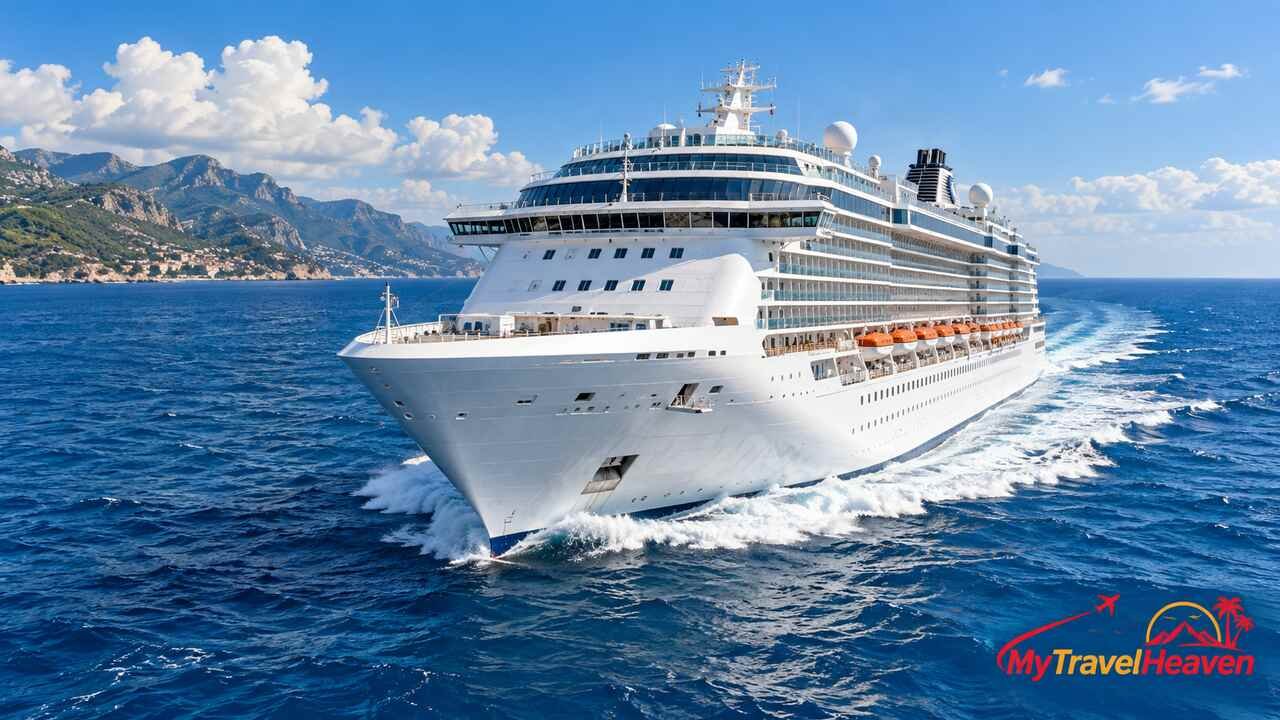
Cruise ships typically travel at around 18 to 22 knots, which equals roughly 21 to 25 mph (33 to 41 km/h). The exact speed depends on the ship, itinerary, weather, sea conditions, and how quickly the vessel needs to reach its next port.
Royal Caribbean, for example, says its ships average about 18 to 20 knots while cruising. Several Princess Cruises ships and Carnival Legend are rated at about 22 knots.
Although cruise ships are capable of moving faster, captains rarely operate them continuously at maximum speed. Maintaining the schedule efficiently and safely is usually more important than getting from one port to another as quickly as possible.
How Fast Do Cruise Ships Normally Go?
A typical cruise ship spends much of its time at sea traveling somewhere between 18 and 22 knots.
In everyday units, that works out to approximately:
| Ship speed | Miles per hour | Kilometers per hour |
|---|---|---|
| 18 knots | 20.7 mph | 33.3 km/h |
| 20 knots | 23.0 mph | 37.0 km/h |
| 22 knots | 25.3 mph | 40.7 km/h |
| 24 knots | 27.6 mph | 44.4 km/h |
| 28 knots | 32.2 mph | 51.9 km/h |
These figures can seem slow compared with a car on a highway, but moving a vessel weighing tens or even hundreds of thousands of gross tons through water requires enormous amounts of power.
Cruise ships also have little reason to maintain their highest possible speed throughout a voyage. If the next port is only a relatively short distance away and the ship has all night to reach it, traveling more slowly can be considerably more efficient.
Why Is Cruise Ship Speed Measured in Knots?
Ships use knots rather than miles per hour because maritime navigation traditionally measures distance in nautical miles.
One knot means one nautical mile traveled per hour. Carnival Cruise Line uses the same definition in its explanation of common nautical terminology.
A knot converts to approximately 1.15 mph or 1.852 km/h.
That means a cruise ship moving at 20 knots is traveling at roughly 23 mph or 37 km/h.
The nautical-mile system is particularly useful at sea because nautical miles relate directly to geographic coordinates used for navigation.
How Fast Are Real Cruise Ships?
Actual specifications show that speeds around 20 to 22 knots are common among modern cruise ships.
| Ship or fleet | Reported speed |
|---|---|
| Royal Caribbean fleet average | About 18 to 20 knots |
| Oasis of the Seas | 22 knots cruising speed |
| Royal Princess | 22 knots service speed |
| Sky Princess | 22 knots maximum speed |
| Carnival Legend | 22 knots cruising speed |
| Queen Mary 2 | 28 knots |
Royal Caribbean states that the average cruising speed across its ships is approximately 18 to 20 knots, depending on the vessel and itinerary. Oasis of the Seas has a listed cruising speed of 22 knots.
Princess Cruises lists Royal Princess at a 22-knot service speed and Sky Princess at a maximum speed of 22 knots. Carnival’s specifications for Carnival Legend also give a cruising speed of 22 knots.
One important exception is Queen Mary 2, which Cunard lists at 28 knots, or about 32 mph. Queen Mary 2 is technically an ocean liner rather than a conventional cruise ship. She was designed partly for regular transatlantic crossings, where higher sustained speeds are particularly useful.
Why Don’t Cruise Ships Travel at Full Speed?
Fuel consumption is one of the biggest reasons.
Moving a large displacement ship faster requires disproportionately more propulsion power. The International Maritime Organization explains that the relationship between vessel speed and required propulsion energy rises sharply as speed increases. Its GreenVoyage2050 guidance notes that reducing a ship’s speed can produce substantial fuel savings.
Cruise schedules also remove much of the need for maximum speed.
Imagine a ship leaves one Caribbean island at 5 p.m. and the next destination is 220 nautical miles away. If it has 12 hours to complete the trip, its required average speed is only:
220 nautical miles ÷ 12 hours = 18.3 knots
There would be little benefit in racing toward the destination at 25 knots and arriving hours before the port is ready to receive the ship.
Operating at an appropriate speed can therefore balance arrival time, fuel use, passenger comfort, weather conditions, and operational requirements.
What Can Change a Cruise Ship’s Speed?
The speed passengers see during a cruise can change considerably from one part of the voyage to another.
The itinerary is often the biggest influence. Two ports located close together may allow the ship to travel relatively slowly overnight. A long distance between ports may require a higher cruising speed.
Weather and sea conditions matter as well. Strong headwinds, waves, and ocean currents can influence the vessel’s speed over the ground and the amount of power required to maintain its schedule. Favorable currents can have the opposite effect.
Ships also reduce speed when approaching ports, traveling through restricted waterways, following traffic-control instructions, or operating where local regulations require slower movement.
The IMO specifically identifies scheduling, weather, currents, port coordination, and voyage planning as factors involved in ship speed management.
How Far Can a Cruise Ship Travel in One Day?
A cruise ship traveling continuously at 20 knots would cover about 480 nautical miles in 24 hours.
The calculation is straightforward:
20 knots × 24 hours = 480 nautical miles
That equals approximately 552 statute miles or 889 kilometers.
At 22 knots, the theoretical distance rises to:
22 × 24 = 528 nautical miles
That is about 608 statute miles or 978 kilometers.
Real voyages do not always maintain one speed for an entire day. Ships may slow down because of traffic, weather, port approaches, itinerary timing, environmental considerations, or operational requirements.
Still, the calculation helps explain how cruise ships can move between countries or islands overnight while passengers sleep.
How Fast Can a Cruise Ship Go at Maximum Speed?
Many conventional cruise ships have maximum or service speeds around the low-20-knot range, although the exact number varies by design.
Maximum speed and normal cruising speed should not be treated as the same thing.
A ship may be physically capable of moving faster than the speed it normally uses during a voyage. Higher speeds may be used when operational circumstances require them, but continually running near maximum output would generally consume more fuel and leave less scheduling flexibility.
Some passenger ships are notably faster. Cunard lists Queen Mary 2 at 28 knots, equivalent to approximately 32 mph or 52 km/h.
Her design reflects a different purpose from that of many resort-style cruise ships. An ocean liner traditionally needs to handle long open-ocean passages and demanding schedules, whereas modern cruise ships are often designed primarily around efficient itineraries, onboard facilities, passenger capacity, and destination experiences.
Does a Bigger Cruise Ship Travel Faster?
Not necessarily.
Ship size alone does not determine speed. Propulsion power, hull design, hydrodynamic resistance, propeller or pod configuration, operating requirements, and intended service all matter.
Oasis of the Seas, for example, is one of the world’s very large passenger ships and has a listed cruising speed of 22 knots. Royal Princess is considerably smaller by gross tonnage but also has a listed 22-knot service speed.
A larger ship can have extremely powerful propulsion systems without being designed to outrun a smaller vessel. Cruise lines typically optimize ships for a combination of efficiency, capacity, comfort, itinerary requirements, and operating economics rather than raw speed.
Can You Feel a Cruise Ship Moving at 20 Knots?
Usually, speed itself is less noticeable than the ship’s movement caused by waves and sea conditions.
A large cruise ship traveling steadily at 20 knots on calm water may feel remarkably stable. Passengers often have few visual clues about how quickly the ship is moving unless they look at the wake or watch the coastline.
Rough seas can make the vessel’s motion more noticeable even when the ship is traveling more slowly. Modern cruise ships also use stabilizing systems designed to reduce rolling motion, although they cannot eliminate movement completely.
Passengers standing on an open deck may notice the ship’s speed more clearly because of wind, while someone sitting inside a restaurant may barely notice that the vessel is moving.
Conclusion
So, how fast do cruise ships go? A useful rule of thumb is about 18 to 22 knots, or roughly 21 to 25 mph during normal cruising. Individual ships can operate above or below that range, and some specialized passenger vessels are considerably faster.
Cruise ships do not normally try to reach their destination as quickly as possible. Their speed is planned around the itinerary, arrival time, fuel efficiency, weather, currents, passenger comfort, and safe navigation. As a result, the speed you see on one night of a cruise may be very different from the speed you see the next.
FAQs
How fast do cruise ships go in mph?
Most cruise ships commonly operate around 18 to 22 knots, equivalent to approximately 21 to 25 mph. Actual speeds change according to the ship and voyage.
How fast do cruise ships go at night?
There is no special nighttime speed. The captain selects a speed based primarily on the distance to the next destination, expected arrival time, weather, traffic, currents, and operating conditions. A ship may travel slowly on one night and much faster on another.
What is 20 knots in mph?
Twenty knots equals approximately 23 mph, or about 37 km/h.
Can cruise ships go 30 mph?
Yes. A ship traveling at about 26 knots is already moving close to 30 mph. However, speeds that high are faster than the normal cruising speed of many conventional cruise ships. Cunard’s Queen Mary 2 is listed at 28 knots, which is roughly 32 mph.
Why do cruise ships sometimes seem to move slowly?
Ships often have plenty of time to reach the next port, so traveling faster would provide little operational benefit while requiring more propulsion energy. Port schedules, weather, currents, traffic restrictions, and fuel efficiency can all influence the chosen speed.
Is a cruise ship faster than a cargo ship?
There is no universal answer because both categories contain vessels designed for different speeds. Many cruise ships operate around 18 to 22 knots, while cargo-ship speeds vary widely according to vessel type, route, cargo, and operating strategy.
