

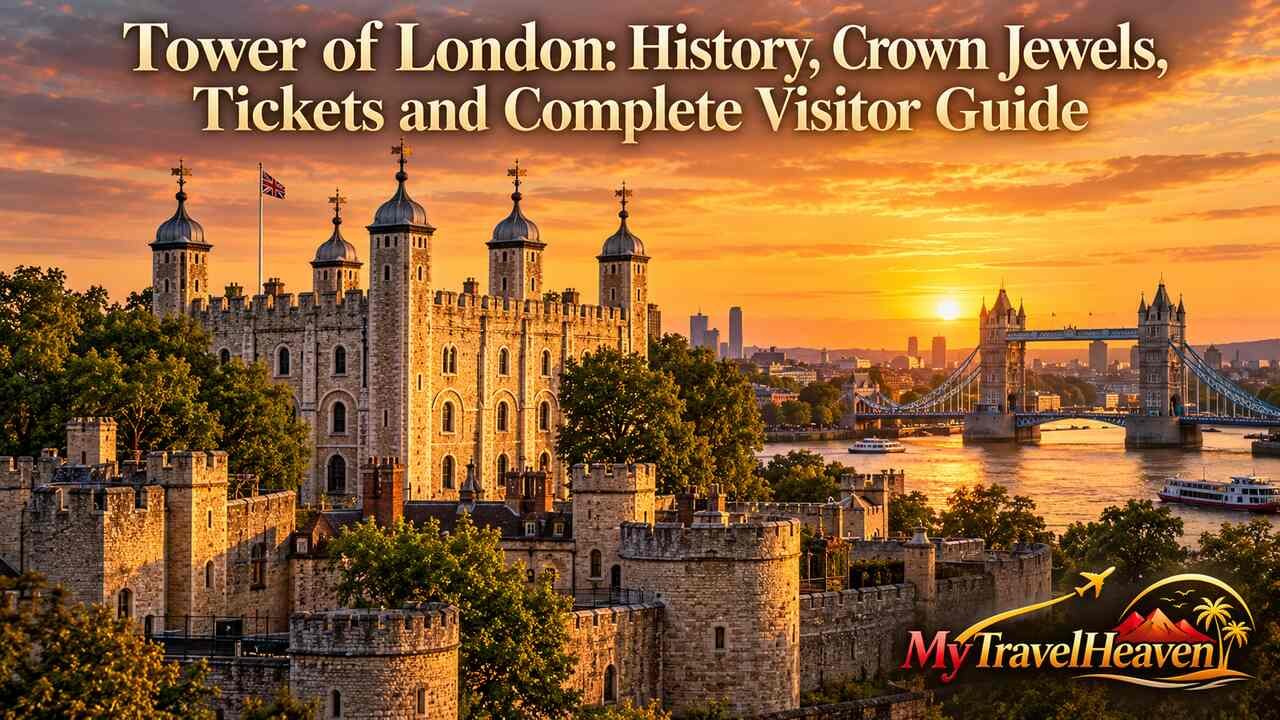
The Tower of London is one of Britain’s most famous historic landmarks, a nearly 1,000-year-old royal fortress on the north bank of the River Thames in central London. Built after the Norman Conquest of 1066, it has served as a royal palace, prison, military stronghold, treasury and home of the Crown Jewels.
Today, the Tower of London is a UNESCO World Heritage Site where visitors can explore medieval towers, see royal crowns and ceremonial treasures, join guided tours led by Yeoman Warders, and discover stories of monarchs, prisoners and executions.
For first-time visitors, the main attractions are the Crown Jewels, White Tower, medieval palace buildings and the famous ravens. Most visitors should allow 2 to 3 hours, although exploring the fortress thoroughly can take longer.
Tower of London at a Glance
| Feature | Details |
|---|---|
| Official name | His Majesty’s Royal Palace and Fortress of the Tower of London |
| Location | Tower Hill, London, EC3N 4AB |
| Founded | Following the Norman Conquest of 1066 |
| White Tower construction | Approximately 1078–1100 |
| Founder | William the Conqueror |
| Original purpose | Royal fortress and symbol of Norman authority |
| UNESCO status | World Heritage Site since 1988 |
| Famous attractions | Crown Jewels, White Tower, ravens, medieval palace |
| Nearest Underground station | Tower Hill |
| Recommended visiting time | 2–3 hours |
| Adult admission | £38, standard ticket excluding donation, as listed in October 2026 |
The Tower is managed by Historic Royal Palaces, an independent charity responsible for caring for several historically significant royal buildings. Its UNESCO designation recognises the fortress’s exceptional Norman architecture and its influence on Britain’s royal and political history.
Where Is the Tower of London Located?
The Tower of London stands beside the River Thames in the London Borough of Tower Hamlets, at the eastern edge of the historic City of London. Its position was strategically important because it allowed Norman rulers to control access to the capital by land and river.
The fortress is situated near Tower Bridge, one of London’s most recognisable bridges. Despite their proximity and similar names, Tower Bridge and the Tower of London are separate attractions with different admission arrangements.
The nearest Underground station is Tower Hill, approximately a five-minute walk away. Visitors arriving at London Bridge or Fenchurch Street stations can generally reach the fortress on foot in about 10 to 15 minutes. Riverboat services also stop at Tower Pier, beside the attraction.
History of the Tower of London
The Tower of London’s history began in the aftermath of the Norman Conquest of England. Over the following centuries, successive monarchs expanded the fortress and adapted it to changing military, political and administrative needs.
William the Conqueror and the Norman Fortress
After defeating King Harold II at the Battle of Hastings in 1066, William the Conqueror sought to establish control over England.
The construction of a major stone fortress in London helped demonstrate his authority. Work on the White Tower, the central keep, began around 1078 and was completed around 1100.
The White Tower was designed to resist attack, accommodate royalty and intimidate potential opponents. Its thick stone walls, elevated position and commanding architecture made it an imposing symbol of the new Norman government.
Expansion During the Medieval Period
During the 13th century, Henry III and Edward I significantly enlarged the Tower’s defensive system.
New walls, towers, royal apartments and a moat transformed the original Norman stronghold into a sophisticated medieval castle complex.
The royal palace within the Tower also became an important ceremonial residence. Monarchs could stay there before major public occasions, including coronations.
The Tower During the Tudor Period
Under the Tudor monarchs, particularly Henry VIII and his successors, the Tower became closely associated with imprisonment and political conflict.
Nobles, religious opponents and individuals accused of treason were imprisoned within its walls. Some were executed inside the fortress, while others met their deaths on nearby Tower Hill.
The imprisonment and execution of Anne Boleyn in 1536 became one of the most famous events in the Tower’s history.
The Tower in Modern British History
The Tower gradually ceased functioning as a principal royal residence, but continued to serve military, administrative and custodial purposes.
It housed the Royal Mint for centuries, maintained armouries and accommodated prisoners during later conflicts, including the Second World War.
Today, it remains a working historic fortress with resident Yeoman Warders, military guards, ceremonial traditions and the Crown Jewels.
Tower of London Historical Timeline
| Period | Major development |
|---|---|
| 1066 | Norman Conquest establishes William I’s rule |
| 1078–1100 | White Tower constructed |
| 12th century | Fortress develops as a royal and administrative centre |
| 13th century | Henry III and Edward I expand defences and palace buildings |
| 1483 | Edward V and his brother are confined at the Tower |
| 1536 | Anne Boleyn is executed on Tower Green |
| 1554 | Lady Jane Grey is executed at the Tower |
| 1660s | Tower becomes the established home of the restored Crown Jewels collection |
| 1941 | Josef Jakobs becomes the last person executed at the Tower |
| 1988 | Tower of London receives UNESCO World Heritage status |
What Is Inside the Tower of London?
The Tower of London is not a single tower. It is a large fortified complex containing multiple historic buildings, exhibition spaces, courtyards, defensive walls and royal sites.
Some areas highlight the monarchy’s wealth and power, while others reveal the conditions experienced by prisoners or the everyday lives of medieval residents.
1. The Crown Jewels
The Crown Jewels are among the Tower’s most popular attractions. The collection contains ceremonial objects used in British coronations and other major state occasions.
Highlights include St Edward’s Crown, traditionally used for the moment of crowning, and the Imperial State Crown, worn for occasions such as the State Opening of Parliament.
Visitors can also see ceremonial swords, sceptres, orbs and other pieces of royal regalia.
One of the most significant gemstones is the Cullinan I diamond, also called the Great Star of Africa, set into the Sovereign’s Sceptre with Cross.
The Crown Jewels are not simply museum objects. Many remain part of the working regalia of the British monarchy.
For visitors particularly interested in seeing them, entering the Jewel House early can help avoid some of the busiest periods.
2. The White Tower
The White Tower is the oldest and most recognisable building in the fortress.
Its Norman architecture reflects the military engineering introduced after the conquest of England. The structure combines defensive features with spaces suited to royal accommodation and religious worship.
Inside, visitors can explore historical armour, weapons and exhibitions associated with the Royal Armouries.
The Chapel of St John the Evangelist, located inside the White Tower, is an especially important example of surviving Norman ecclesiastical architecture.
Visitors should be prepared for historic staircases. The upper floors have no lift access, although lift access is available to the basement gallery and shop.
3. The Medieval Palace
The Medieval Palace exhibitions reveal how medieval kings and queens lived within the Tower’s walls.
Although the fortress is often remembered for imprisonment and executions, it was also a comfortable royal residence by medieval standards.
Reconstructed interiors, furnishings and interpretation help visitors understand the contrast between royal domestic life and the heavily defended castle surrounding it.
The exhibition areas associated with St Thomas’s Tower, the Wakefield Tower and the Lanthorn Tower provide insight into the medieval royal household.
4. The Bloody Tower
The Bloody Tower is closely associated with the mysterious disappearance of the Princes in the Tower.
The two boys, Edward V and his younger brother Richard, Duke of York, disappeared from public view in 1483 during the struggle for the English throne.
Their precise fate remains unknown, although their uncle, Richard III, has long been suspected of involvement.
The Bloody Tower also has links to later prisoners, including Sir Walter Raleigh.
It is an especially interesting stop for visitors curious about royal succession, political intrigue and unresolved historical mysteries.
5. Tower Green and the Execution Site
Tower Green was the site of several private executions, including those of Anne Boleyn, Catherine Howard and Lady Jane Grey.
Unlike executions on Tower Hill outside the fortress, executions within the Tower grounds were relatively unusual and typically reserved for people of particularly high status.
A memorial marks the execution site, creating a place for reflection on the personal consequences of political conflict.
Nearby stands the Chapel Royal of St Peter ad Vincula, where several prominent prisoners and execution victims were buried.
6. The Ravens of the Tower of London
The Tower’s resident ravens are among its most distinctive traditions.
According to a famous legend, the kingdom will fall if the ravens ever leave the Tower. The birds are cared for by a dedicated Ravenmaster and the Tower’s raven team.
The legend is part of the Tower’s folklore rather than a documented medieval prophecy. Its popularity reflects how the fortress has accumulated traditions and stories over many centuries.
Visitors may see ravens moving freely through parts of the grounds. They are powerful wild birds, however, and should not be fed or approached too closely.
7. The Yeoman Warder Tours
Yeoman Warders, commonly called Beefeaters, are ceremonial guardians of the Tower and among its best-known residents.
They lead guided tours that explain the history of imprisonment, royal life, execution and military service at the fortress.
The tours are included with standard admission and are especially valuable for understanding how the different buildings relate to one another.
Tours normally run at regular intervals, typically every 45 minutes, and cannot be reserved individually in advance. The historic routes involve uneven surfaces and some steps.
Famous Prisoners and Executions at the Tower of London
The Tower became notorious as a prison because it held people considered threats to the monarchy. However, it was not an ordinary public jail. Many prisoners were politically important individuals whose treatment depended on their status, influence and the decisions of the reigning monarch.
Some prisoners occupied relatively comfortable rooms, while others experienced harsh confinement and interrogation.
Anne Boleyn
Anne Boleyn, Henry VIII’s second wife, was arrested in 1536 and accused of adultery, incest and treason. She was found guilty and executed on Tower Green on 19 May 1536.
Historians widely question the credibility of the accusations against her. Her downfall is closely connected to the political and dynastic pressures surrounding Henry VIII’s search for a male heir.
Lady Jane Grey
Lady Jane Grey became queen in July 1553 but held the title for only nine days before Mary I secured the throne.
Jane was subsequently imprisoned and executed at the Tower in February 1554, aged approximately 16 or 17.
Her story illustrates the dangers of disputed succession in Tudor England.
Sir Thomas More
Sir Thomas More, a former Lord Chancellor, was imprisoned after refusing to accept Henry VIII’s religious supremacy.
He was executed on Tower Hill in 1535, rather than inside the fortress.
Sir Walter Raleigh
Sir Walter Raleigh, the explorer, courtier and writer, was imprisoned in the Tower during the reigns of Elizabeth I and James I.
His imprisonment illustrates another side of Tower life, since prisoners of high status could sometimes occupy furnished rooms, receive visitors and continue intellectual work.
Was the Tower of London Really a Torture Chamber?
The Tower of London has a strong reputation for torture, but its historical use of torture was more limited than popular legends often suggest.
Torture was used in particular political and religious investigations, especially during the 16th and 17th centuries. Devices associated with the Tower included the rack, which stretched a prisoner’s body, and the manacles, which could suspend prisoners by their wrists.
Torture was not, however, the routine experience of every person imprisoned at the Tower.
The White Tower contains displays concerning instruments of torture, but visitors should distinguish surviving evidence from later sensational accounts. Some popular stories exaggerate how frequently these methods were used.
One further distinction matters: the Tower was a place of imprisonment for many centuries, but most public executions associated with it occurred outside its walls on Tower Hill.
Tower of London Tickets and Prices in 2026
Standard admission to the Tower of London provides access to its main visitor attractions, including the Crown Jewels, White Tower and available Yeoman Warder tours.
The following prices are listed for October 2026. They exclude the optional charitable donation.
| Visitor category | Standard ticket |
|---|---|
| Adult, ages 18–64 | £38.00 |
| Child, ages 5–15 | £19.00 |
| Young person, ages 16–17 | £19.00 |
| Child under 5 | Free |
| Senior, 65+ | £30.30 |
| Full-time student, 18+ | £30.30 |
| Disabled concession | £30.30 |
| Eligible accompanying carer | Free |
| Eligible benefits recipient | From £1.00 |
For example, a family of two adults and two children aged between 5 and 15 would pay £114 for standard admission without the optional donation.
The £1 ticket scheme applies only to visitors meeting specified benefits eligibility requirements, so applicants should check the conditions before booking.
Ticket prices can change, particularly when seasonal offers, special events or concession policies are updated.
Is Booking in Advance Necessary?
Advance booking is recommended, particularly during school holidays, weekends and busy tourist periods. Booking ahead allows visitors to plan their arrival and reduces the risk of preferred admission slots being unavailable.
The standard admission ticket covers the main historical attractions, but some specialist experiences and evening ceremonies require separate reservations.
Tower of London Opening Times
Opening hours vary by season, day and special events. For the week of 5–11 October 2026, the published schedule lists 09:00 to 17:30 opening on Tuesday through Saturday, and 10:00 to 17:30 on Monday and Sunday.
For that week, last entry is listed as 16:30. The last Yeoman Warder tour begins at 15:15.
Opening arrangements can change because of ceremonies, maintenance or temporary closures, so visitors should check the calendar for their specific date.
What Is the Best Time to Visit?
The best time depends on what visitors most want to see.
Morning visits are useful for those who want to prioritise the Crown Jewels before queues potentially build. The grounds also tend to be quieter after midday.
Spring and autumn can offer pleasant conditions for walking around the outdoor areas. Summer provides longer daylight hours, but school holidays can bring heavier demand.
Visitors should avoid assuming that a late-afternoon arrival leaves enough time to see everything. Some buildings may close before the grounds, and guided tours finish earlier than general admission.
How Long Do You Need at the Tower of London?
Most visitors need 2 to 3 hours to see the principal attractions. History enthusiasts may prefer 4 hours or more, particularly if they want to attend a guided tour and examine the exhibitions carefully.
The following itinerary provides a practical route for a first-time visit.
| Approximate time | Suggested activity |
|---|---|
| 0–35 minutes | Visit the Crown Jewels |
| 35–70 minutes | Explore the White Tower |
| 70–110 minutes | Join an available Yeoman Warder tour |
| 110–135 minutes | Explore the Medieval Palace or Bloody Tower |
| 135–160 minutes | Visit Tower Green, see the ravens and walk through the grounds |
| 160–180 minutes | Revisit an exhibition or explore the shop |
This schedule is illustrative, not a fixed visiting timetable. Tour start times, queues, exhibition access and visitor preferences can change the order substantially.
A useful approach is to select three priorities before arriving. Visitors with limited time could focus on the Crown Jewels, White Tower and one guided tour rather than trying to see every part of the castle.
How to Get to the Tower of London
The Tower is easily accessible by public transport, and most tourists do not need a car.
The closest Underground station, Tower Hill, is served by the District and Circle lines. Tower Gateway DLR station is another nearby option.
London Bridge and Fenchurch Street railway stations are also within walking distance. Riverboat services offer a scenic alternative, with Tower Pier beside the attraction.
Driving is generally less convenient because there is no visitor parking inside the Tower grounds and central London traffic restrictions and charges may apply.
Is the Tower of London Accessible to Everyone?
The Tower provides accessibility support, but its medieval design creates significant physical limitations.
Much of the site has cobbled surfaces, narrow passages, steep stairs and low doorways. Some historic buildings and upper floors are inaccessible to wheelchair users.
Accessibility support includes information about alternative routes and digital virtual tours for selected inaccessible spaces.
Eligible visitors with disabilities can bring an accompanying carer or companion free of charge. Wheelchair users and visitors with mobility requirements should check the individual attractions before booking, rather than assuming that every exhibition has step-free access.
The Ceremony of the Keys: A Historic Nighttime Tradition
The Ceremony of the Keys is the traditional nightly locking of the Tower of London.
During the ceremony, a Yeoman Warder carries the keys, accompanied by military guards, as the fortress is formally secured for the night.
The ceremony is associated with centuries of royal security traditions and remains one of the Tower’s most distinctive experiences.
Unlike the standard daytime attractions, the Ceremony of the Keys requires a separate ticket and advance booking.
As listed in October 2026, the experience runs from approximately 21:30 to 22:05. Tickets are offered on a flexible-price basis from £10 to £50, with a suggested contribution of £30. Booking arrangements and prices may change.
Visitors should not confuse this experience with the Yeoman Warder tours included in general admission.
Lesser-Known Facts About the Tower of London
It Once Housed a Royal Zoo
For centuries, the Tower was home to a collection of exotic animals known as the Royal Menagerie.
The animals included lions and other creatures presented to the English monarchy. The menagerie became an unusual symbol of royal wealth and international diplomatic relationships.
During the 19th century, the remaining animals were transferred away from the Tower, including to the developing London Zoo.
The Royal Mint Operated Here for Centuries
Coin production was another important Tower function.
The Royal Mint operated within the Tower complex for hundreds of years before moving to new premises in the early 19th century.
This shows that the fortress was more than a defensive structure. It also supported institutions central to England’s economy and government.
The Tower’s History Includes the Persecution of Medieval Jews
The Tower’s history contains difficult chapters that receive less attention than its famous Tudor prisoners.
Medieval Jewish communities sometimes sought protection within the fortress, but Jewish people were also imprisoned and persecuted there.
The Tower’s history is connected with anti-Jewish violence, discriminatory taxation and Edward I’s expulsion of Jewish people from England in 1290.
This history adds an important perspective to the site’s role as an instrument of royal power.
People Still Live at the Tower
The Tower is not exclusively a museum. Yeoman Warders and their families live within its walls, maintaining a connection between the historic fortress and its continuing ceremonial responsibilities.
It Is One of Europe’s Most Important Surviving Norman Castles
The White Tower is regarded as an exceptionally complete surviving example of an 11th-century fortress palace.
Its design influenced castle construction elsewhere in England and helps explain why UNESCO recognises the Tower as a site of outstanding historical and architectural importance.
Is the Tower of London Worth Visiting?
The Tower of London is especially worthwhile for visitors interested in British history, royal traditions, medieval architecture and famous historical mysteries.
Its main advantage over many conventional museums is that visitors explore the actual buildings where important events took place. The fortress itself provides historical context that replicas and exhibition displays cannot fully reproduce.
However, the relatively high admission price, potential queues and limited accessibility in some areas are worth considering.
For families, the ravens, armour displays and stories told by Yeoman Warders can be particularly engaging. Some accounts of torture and executions may be unsettling for younger children.
Visitors with only one or two days in London should weigh the Tower against their other priorities. Those who want to see the Crown Jewels and experience nearly a thousand years of English history in one location will find it particularly rewarding.
Conclusion
The Tower of London is much more than a medieval castle. It is a surviving centre of royal history that reveals how England’s monarchy, military defences, government institutions and political conflicts developed over nearly a thousand years.
From the Norman White Tower and priceless Crown Jewels to the stories of Anne Boleyn, the Princes in the Tower and the famous ravens, the fortress combines architecture, history and living traditions in one remarkable location.
For the most rewarding visit, book admission in advance, allow at least 2 to 3 hours and prioritise the attractions that interest you most. Check opening times and ticket arrangements before travelling, particularly if you want to attend a Yeoman Warder tour or a special ceremony.
FAQs
1. Who Built the Tower of London?
William the Conqueror founded the Tower of London following the Norman Conquest in 1066. Construction of the White Tower began around 1078 and was completed around 1100. Later monarchs expanded the fortress with additional walls, towers and palace buildings.
2. Are the Crown Jewels Kept at the Tower of London?
Yes. The Tower of London houses the Crown Jewels, including ceremonial crowns, sceptres and other royal regalia. The collection remains connected to official royal ceremonies and is one of the fortress’s most important attractions.
3. Can You Visit the Tower of London for Free?
General admission normally requires a ticket. Children under five and certain eligible visitors can enter free, while qualifying benefits recipients may be able to purchase discounted tickets. The surrounding public areas offer exterior views of the fortress without admission.
4. Is the Tower of London the Same as Tower Bridge?
No. The Tower of London is a medieval royal fortress, while Tower Bridge is a separate Victorian-era bridge across the River Thames. They stand close together, but each has its own history, attractions and admission arrangements.
5. Was Queen Elizabeth I Imprisoned in the Tower of London?
Yes. The future Elizabeth I was imprisoned at the Tower in 1554 during the reign of her half-sister, Mary I. She was later released and became queen in 1558, ruling England until 1603.
6. Can You Take Photographs Inside the Tower of London?
Photography is allowed in many areas of the fortress, but restrictions apply in certain exhibitions, particularly the Crown Jewels display. Visitors should follow the signage and staff instructions in each building.
