

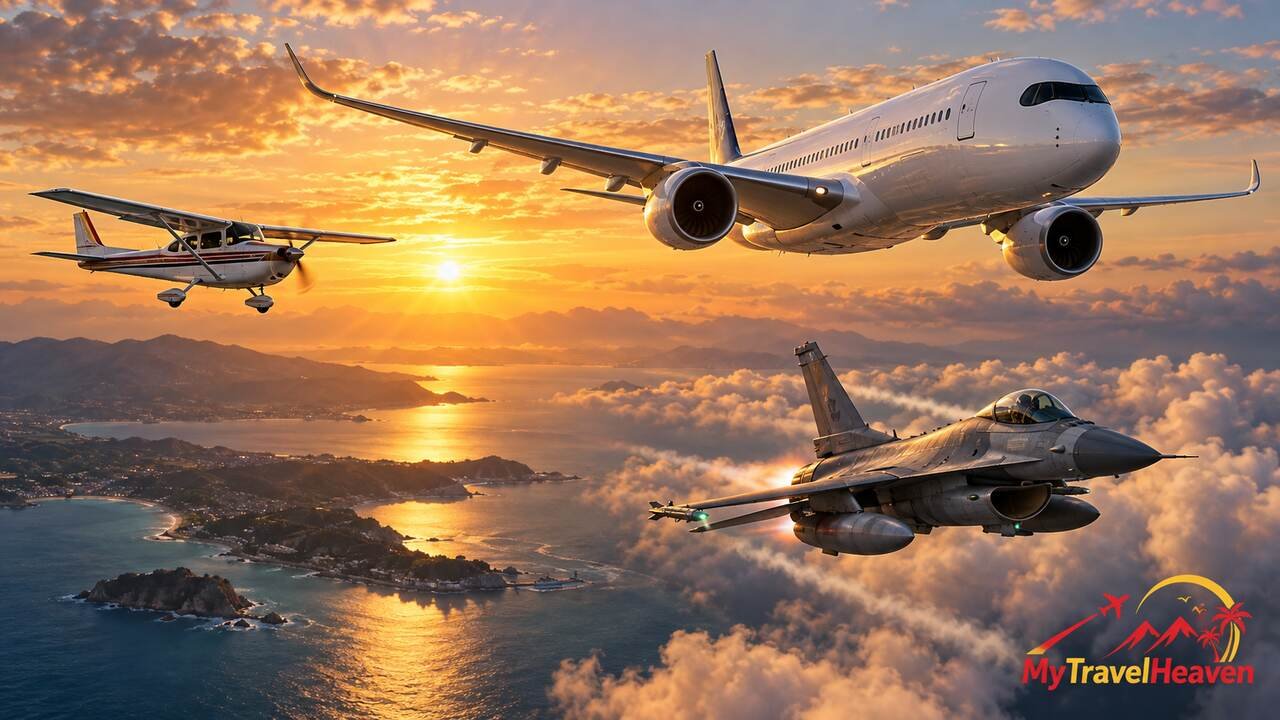
A typical commercial passenger plane flies at around 500 to 600 mph (805 to 965 km/h) while cruising. Smaller propeller planes are much slower, while some military fighter jets can exceed 1,500 mph (2,400 km/h).
There is no single answer to how fast a plane goes because aircraft speed changes with the type of plane, altitude, flight phase, weather, weight, and wind. A plane also has several different ways of measuring speed, including airspeed, ground speed, and Mach number.
How Fast Does a Plane Go? Quick Comparison
The biggest difference in plane speeds comes from the aircraft’s design and purpose. A four-seat training aircraft does not need the same speed as a long-distance airliner, and a passenger jet is not designed to reach the extreme speeds of a military fighter.
| Type of plane | Typical or example speed | Approximate mph | Approximate km/h |
|---|---|---|---|
| Small piston plane | 124 knots | 143 mph | 230 km/h |
| Commercial passenger jet | Mach 0.79 to 0.85 | Roughly 520 to 560 mph at cruising altitude | Roughly 840 to 900 km/h |
| High-speed business jet | Mach 0.90 | Roughly 595 mph at cruising altitude | Roughly 960 km/h |
| Supersonic fighter jet | Mach 2 | Around 1,500 mph at altitude | Around 2,400 km/h |
These figures should be treated as examples rather than universal limits. Atmospheric conditions affect the relationship between Mach number and mph, while wind can make a plane’s speed over the ground considerably higher or lower than its speed through the surrounding air.
For example, Textron Aviation lists a maximum cruise speed of 124 KTAS, or 230 km/h, for the Cessna Skyhawk, a widely used four-seat piston aircraft. At the other end of civilian aviation, Boeing documents a Mach 0.85 cruise speed for the 787-8 Dreamliner.
How Fast Do Passenger Planes Fly?
Most modern passenger jets cruise at approximately Mach 0.78 to Mach 0.85. At normal airline cruising altitudes, that generally works out to roughly 500 to 600 mph, although the exact conversion changes with atmospheric temperature.
A Boeing 787-8, for example, is designed around a Mach 0.85 long-range cruise speed. Boeing also lists a typical cruise speed of Mach 0.79 for its 737-based Boeing Business Jet models.
Airbus aircraft operate in a similar speed range. Airbus documentation lists a maximum operating Mach number of 0.82 for the A320 Family. That number is an operating limit rather than the speed the aircraft necessarily flies during every cruise.
Airlines generally do not try to fly their planes at the maximum possible speed. Cruise speed represents a balance among travel time, fuel consumption, engine performance, weather, air traffic requirements, and the aircraft’s operating limits.
Why don’t passenger planes simply fly faster?
Increasing an aircraft’s speed increases aerodynamic and propulsion demands. As a conventional jet gets closer to the speed of sound, compressibility effects and drag become increasingly significant.
NASA explains that these effects become especially important as an aircraft approaches Mach 1. Shock waves can develop, changing lift and drag characteristics. This is one reason conventional subsonic airliners cruise comfortably below the speed of sound rather than trying to operate close to Mach 1.
Flying somewhat slower can also reduce fuel consumption. Airlines therefore choose speeds according to operating economics and flight conditions rather than simply asking how fast the airplane can physically travel.
How Fast Do Small Planes Go?
Small general-aviation aircraft are usually much slower than passenger jets.
The Cessna Skyhawk, commonly known as the Cessna 172, provides a useful example. Its manufacturer lists a maximum cruise speed of:
- 124 knots true airspeed
- 230 km/h
- Approximately 143 mph
Textron Aviation also lists the Skyhawk’s maximum limiting indicated airspeed at 163 knots and its stall speed at 48 knots calibrated airspeed.
Those numbers illustrate an important point: a plane does not have just one speed. The appropriate speed depends on whether it is taking off, climbing, cruising, descending, approaching, or landing.
Small aircraft generally trade speed for other priorities such as lower operating costs, shorter runway requirements, simpler systems, flight-training suitability, and access to smaller airports.
How Fast Do Private Jets Go?
Many modern private jets fly about as fast as, or sometimes faster than, commercial airliners.
The Gulfstream G700, for example, has:
- Long-range cruise: Mach 0.85
- High-speed cruise: Mach 0.90
- Maximum operating Mach number: Mach 0.935
Gulfstream notes that actual range is affected by weather, routing, operating speed, aircraft configuration, and other factors.
This helps explain why a private jet can sometimes complete a journey noticeably faster than a scheduled airline flight even when their cruising speeds are similar. The advantage may come from more direct routing, different airports, shorter ground procedures, or the ability to operate according to a customized schedule, rather than dramatically greater airborne speed.
How Fast Do Fighter Jets Go?
Some military fighter aircraft can travel more than twice the speed of sound.
The U.S. Air Force lists the F-16 Fighting Falcon at approximately 1,500 mph, or Mach 2 at altitude.
That is nearly three times the cruising speed of many passenger aircraft.
However, a fighter capable of Mach 2 does not normally spend an entire mission traveling at that speed. High-speed flight can consume enormous amounts of fuel, and an aircraft’s achievable speed depends on factors such as altitude, payload, external fuel tanks, weapons, maneuvering, and engine settings.
Therefore, “maximum speed” and “normal operating speed” should not be treated as the same thing.
How Fast Is a Plane During Takeoff?
There is no universal takeoff speed for airplanes.
Pilots calculate takeoff speeds for each flight based on factors including:
- Aircraft model
- Aircraft weight
- Runway length
- Runway condition
- Temperature
- Airport elevation
- Wind
- Flap configuration
- Engine performance
Large passenger aircraft use several important calculated takeoff speeds, commonly referred to as V1, VR, and V2. The exact values vary from flight to flight.
Airbus describes systems that check the aircraft’s entered weight and calculated takeoff speeds and verify that the available runway is sufficient for the expected takeoff performance.
This is why saying that “a passenger plane takes off at exactly 160 mph,” for example, would be misleading. Two flights operated by the same type of aircraft can have different takeoff speeds because their weight and operating conditions differ.
How Fast Is a Plane When It Lands?
Landing speed also changes according to aircraft type, weight, wind, configuration, and operating conditions.
A passenger jet normally approaches the runway far more slowly than it travels during cruise. As an illustration of the scale involved, an Airbus technical example shows an approach speed of 141 knots in one particular landing-performance scenario. That figure is an example, not a universal landing speed for Airbus aircraft.
The wings generate sufficient lift at these lower speeds because pilots extend devices such as flaps and slats, which change the wing’s aerodynamic characteristics for takeoff and landing.
Once the aircraft touches down, aerodynamic drag, wheel brakes, spoilers, and, where applicable, reverse thrust help reduce its speed.
Airspeed and Ground Speed Are Not the Same
One reason plane speeds can seem confusing is that aviation uses several measurements of speed.
The two most useful for a passenger to understand are true airspeed and ground speed.
The FAA describes true airspeed as the aircraft’s speed through the surrounding air. Ground speed is the aircraft’s actual speed relative to Earth’s surface and is affected by wind.
Consider a simplified example:
| Situation | True airspeed | Wind | Approximate ground speed |
|---|---|---|---|
| No wind | 500 mph | 0 mph | 500 mph |
| Strong tailwind | 500 mph | 100 mph from behind | 600 mph |
| Strong headwind | 500 mph | 100 mph from ahead | 400 mph |
The real calculation can be more complicated when the wind is not directly aligned with the aircraft’s course, but the example shows why the speed displayed on an in-flight entertainment screen can change considerably even when the pilots have not dramatically changed the airplane’s cruise setting.
Can a Passenger Plane Travel Faster Than 600 mph?
Its ground speed can, particularly when a strong tailwind is present.
Imagine an aircraft flying through the air at around 550 mph while benefiting from a 100 mph tailwind. Its ground speed could approach 650 mph even though the aircraft itself is still operating at a normal subsonic airspeed.
This does not mean the aircraft has broken the sound barrier.
The FAA specifically distinguishes ground speed from the aircraft’s speed relative to the surrounding air.
That distinction explains occasional reports of commercial jets recording exceptionally high ground speeds during strong upper-level winds.
What Does Mach Mean for a Plane?
Mach number compares an object’s speed with the local speed of sound.
NASA defines Mach number as the ratio between the speed of an object and the speed of sound in the surrounding gas.
So:
Mach 1 = the local speed of sound
Mach 0.8 = 80% of the local speed of sound
Mach 2 = twice the local speed of sound
The important word is local.
The speed of sound changes with atmospheric conditions, particularly temperature. NASA gives a sea-level reference of roughly 760 mph, but that should not be used as a fixed conversion at every altitude.
That is why saying “Mach 0.85 always equals exactly 646 mph” would be incorrect. At the cold temperatures found at normal jet cruising altitudes, the local speed of sound differs from its sea-level value.
Can Planes Fly Faster Than the Speed of Sound?
Yes. Supersonic military and experimental aircraft can exceed Mach 1.
The F-16, for example, is capable of approximately Mach 2 at altitude according to the U.S. Air Force.
Supersonic research also continues. On June 5, 2026, NASA reported that its experimental X-59 reached approximately Mach 1.1, or 713 mph, during its first supersonic flight.
Normal commercial passenger services, however, currently operate below Mach 1. Modern airliners are designed primarily around efficiency, range, capacity, reliability, noise constraints, and operating economics rather than maximum possible speed.
What Determines How Fast a Plane Can Go?
Aircraft speed results from several interacting factors rather than engine power alone.
Aircraft design: Wing shape, fuselage design, engine type, drag, structural limits, and aerodynamic configuration determine the aircraft’s operating envelope.
Altitude: Jet aircraft typically achieve efficient high-speed cruise at high altitude, where air density is lower. The relationship among indicated airspeed, true airspeed, and Mach number also changes with altitude.
Weight: A heavily loaded aircraft may use different climb, takeoff, and approach speeds from a lighter aircraft.
Weather: Winds strongly influence ground speed. Temperature also affects air density, engine performance, and the speed of sound.
Flight phase: An aircraft deliberately flies at very different speeds during takeoff, climb, cruise, descent, approach, and landing.
Air traffic control: Controllers may request particular speeds to safely maintain spacing between aircraft. FAA procedures include speed instructions expressed in knots or Mach number.
Fuel efficiency: Maximum speed is rarely the most economical speed. Airlines and business aircraft operators choose cruise profiles that balance time and fuel consumption.
Why Are Plane Speeds Usually Measured in Knots?
Aviation commonly uses knots rather than miles per hour.
One knot equals:
- 1 nautical mile per hour
- About 1.151 mph
- Exactly 1.852 km/h
Nautical miles are closely connected with geographic navigation, which makes knots particularly practical for marine and aviation operations.
For a quick conversion:
250 knots ≈ 288 mph ≈ 463 km/h
450 knots ≈ 518 mph ≈ 833 km/h
500 knots ≈ 575 mph ≈ 926 km/h
Pilots may also use Mach number at high altitude, particularly on high-speed jet aircraft. FAA procedures explicitly provide for air traffic controllers to issue speeds either in knots or Mach number.
How Long Would a Plane Take to Travel 1,000 Miles?
A simple speed calculation helps put aircraft performance into perspective.
Suppose an aircraft has a ground speed of 500 mph:
1,000 miles ÷ 500 mph = 2 hours
That does not mean a scheduled 1,000-mile flight will take exactly two hours.
Actual journey time can include:
- Taxiing
- Takeoff
- Climbing
- Routing that is longer than a straight line
- Air traffic restrictions
- Headwinds or tailwinds
- Descent
- Approach
- Taxiing to the gate
This distinction explains why dividing route distance by an airliner’s advertised cruise speed does not always match the scheduled flight duration.
Conclusion
So, how fast does a plane go? For a typical passenger jet, a useful answer is about 500 to 600 mph during cruise. A small aircraft such as a Cessna Skyhawk may cruise at around 143 mph, while supersonic fighters such as the F-16 can reach around 1,500 mph at altitude.
The number seen by passengers can vary because aircraft speed is more complicated than a car’s speedometer reading. Airspeed, ground speed, wind, altitude, Mach number, aircraft weight, and flight phase all matter. For airline travel, the most useful distinction is that the airplane’s speed through the air may remain relatively steady while its speed across the ground changes significantly because of wind.
FAQs
How fast does a normal passenger plane go?
A modern passenger jet typically cruises at roughly 500 to 600 mph (805 to 965 km/h). Aircraft such as the Boeing 787 cruise around Mach 0.85, although exact speed varies with altitude and operating conditions.
Is 500 mph fast for a plane?
It is a normal cruising speed for many commercial jets. It would be extremely fast for a small piston aircraft, but relatively slow compared with a supersonic fighter.
How fast does a Boeing 747 or 787 fly?
Large Boeing passenger jets generally cruise well below the speed of sound. Boeing documents a cruise speed of Mach 0.85 for the 787-8. Actual ground speed can be higher or lower depending largely on wind.
Can a plane go 1,000 mph?
Some military aircraft can. The F-16 is rated at approximately 1,500 mph at altitude, according to the U.S. Air Force. Ordinary passenger jets do not operate at 1,000 mph.
Why does my flight screen sometimes show more than 600 mph?
The display may be showing ground speed. A powerful tailwind can increase an aircraft’s speed relative to the ground even though its speed through the surrounding air remains within its normal operating range.
Do planes fly at full speed for the entire flight?
No. Aircraft accelerate for takeoff, climb at appropriate speeds, settle into an efficient cruise, and then slow during descent and approach. Even during cruise, operators normally select an efficient operating speed rather than the aircraft’s absolute maximum speed.
